Pressed cane or hand-woven cane: which one is on your chair?
Two kinds of cane fail in different ways, and a couple of photos will tell you which one you have.
October 21, 2026 · 3 min read
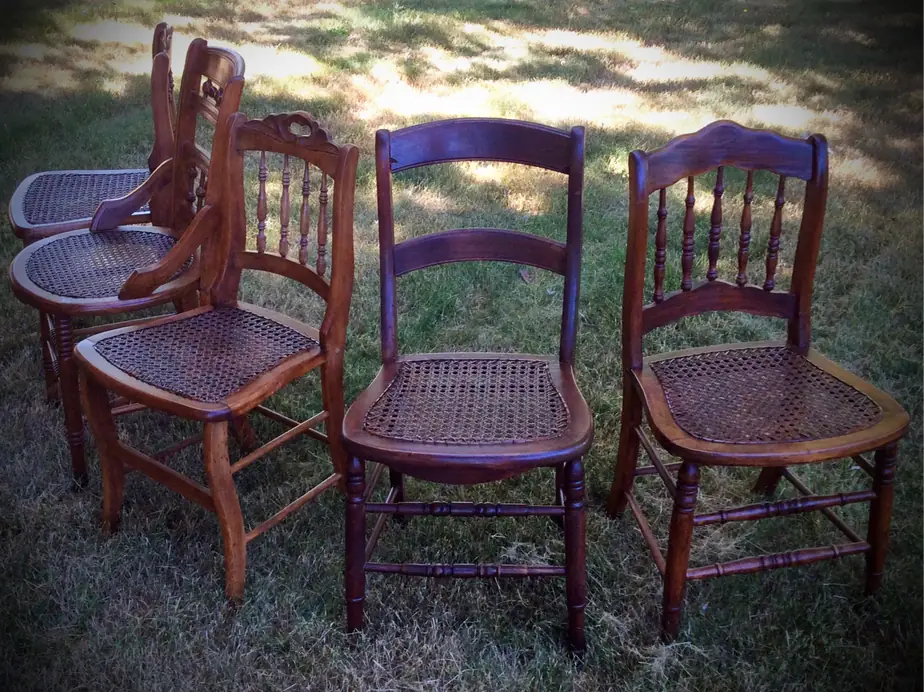
Cane seats and backs come in two main families, and they fail in different ways. Knowing which one you have helps you describe your chair clearly, and it helps you set realistic expectations before anybody picks up a tool.
Sassafrassity lists pressed cane replacement among its services, finished or natural, and mentions cane weaving as something to ask about. Here's the general know-how behind those words, so your first email makes sense.
Two kinds of cane, one quick test
Hand-woven cane is made from individual strands threaded through holes drilled around the seat frame. You'll often see pegs, small wooden plugs tucked into those holes, and the strands pass over and under each other in several layers, usually forming an eight-sided star pattern. Turn the chair over and you'll see the knots and the loose ends tied off underneath.
Pressed cane, sometimes called sheet cane or pre-woven cane, arrives as a flat woven mat. It's laid over a groove cut around the seat opening and held there by a thin strip of reed called a spline, pressed into the groove with glue. If you see a channel running around the edge of the seat with a strip tucked into it, you have pressed cane. No holes, no pegs.
Take a photo of the edge and another of the underside. Those two pictures answer the question almost every time.
How pressed cane wears out
A sheet of cane lasts a long time, but it isn't forever. Common problems include a seat that sags in the middle, strands that have snapped where people sit, and an edge where the spline has dried out and popped loose from the groove. Cane is a natural fiber, and heat, dryness, and long use all take their toll.
One failure to watch for is a seat that looks fine but feels springy and starts to give. Fibers tire out before they break. Another is a dark stain in one corner after something spilled. Both are usually handled by replacing the sheet, which is generally a cleaner fix than patching a single section.
It's also worth saying what pressed cane isn't. It isn't ruined just because it's dusty or has a little tone variation. Honest age can look pretty good on a vintage chair.
Finished or natural
The studio offers pressed cane replacement finished or natural, and in general the difference works like this. Natural cane is left in its pale, raw straw color, which warms up and deepens with time. A finished seat has a stain or clear coat applied, so it can match the surrounding wood and shrug off a bit more dust and moisture.
Which one suits you depends on the frame. A dark walnut chair with a pale seat is a striking contrast, and some people adore it. Others want the seat to disappear into the frame. Neither is wrong. If you aren't sure, say so in your email and send a picture of the room.
Why a patch rarely works
People ask whether a broken strand can just be patched. For pressed cane, the honest general answer is that the sheet works as a tension system. Each strand holds its neighbors, so a damaged area tends to spread. A new sheet, set in the groove and dampened so it tightens as it dries, usually does better than a patchwork.
Hand-woven seats are a different craft, and they take more time by nature, since every strand goes in one at a time. The studio mentions cane weaving as something to ask about, so if your chair has pegs and knots, say so in your message and let the owner tell you what's possible.
Caring for cane
- Keep it out of direct sun for long stretches, which dries and bleaches the fibers.
- Wipe with a slightly damp cloth and dry it right away. Don't soak a seat.
- Vacuum dust with a soft brush attachment, since grit works its way into the weave.
- Don't stand on a cane seat to reach a high shelf. Concentrated weight breaks strands.
- Watch for a loose spline edge and mention it early.
Cane likes steady, moderate humidity. A heating vent blowing on it all winter will make it brittle, so shift the chair a couple of feet if you can.
Send the photos
If you've got a cane chair at home, email pictures of the seat from above, the edge, and the underside to sassafrassity@hotmail.com, and mention whether you'd like finished or natural. You can also call 503-245-2453. Pick up and delivery services are available, which helps when the chair is awkward to carry.
Sassafrassity, 503-245-2453
Call 503-245-2453More articles
Is this chair worth saving? A ten-minute test
Most chairs don't get thrown out because they broke, so here's how to tell what's really wrong with yours.
How to photograph a chair for an upholstery quote
A good set of pictures saves days of back and forth, and you don't need a fancy camera to take them.